On this page
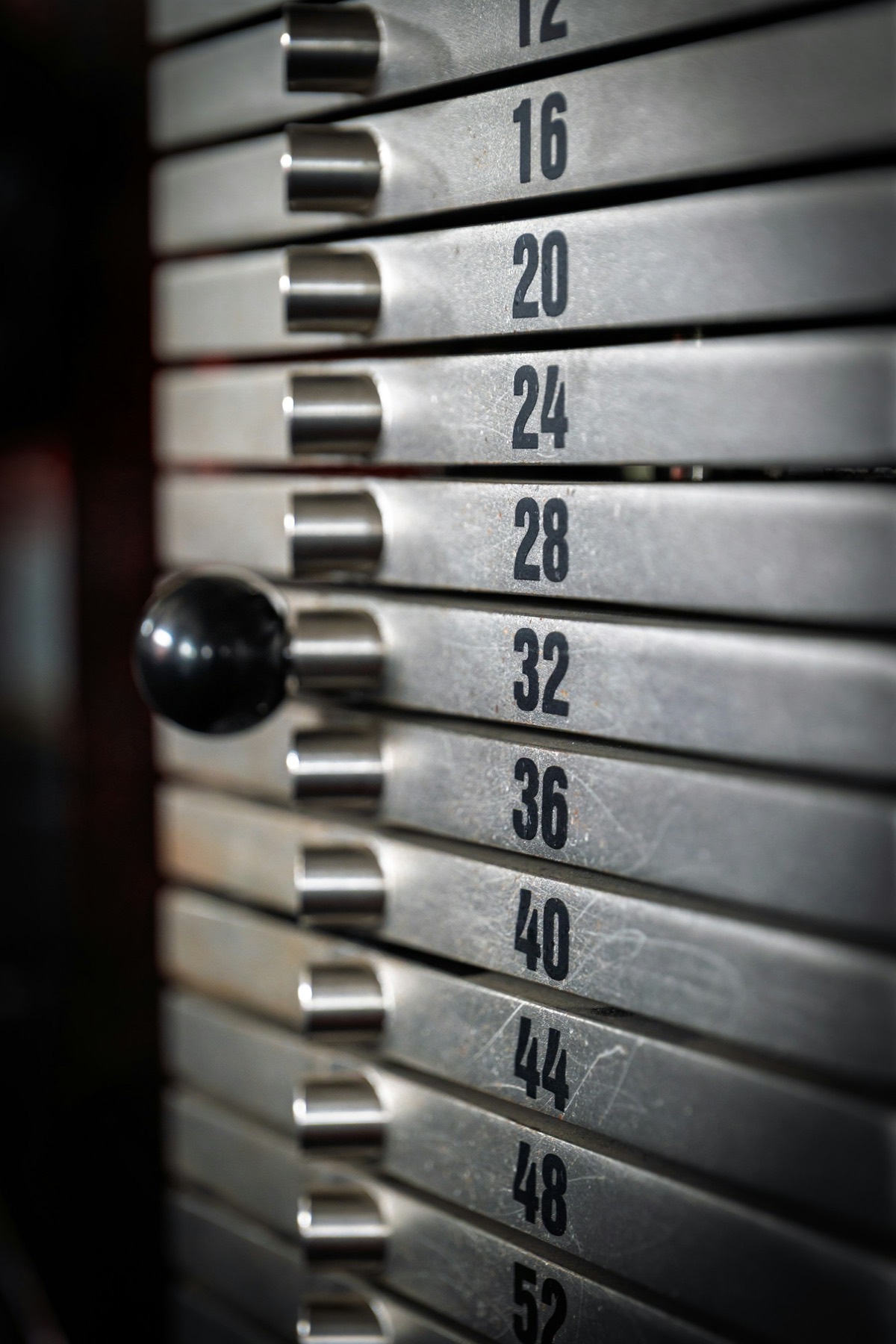
There is no correct number of plates for the abductor machine, because stacks, pulley ratios and lever lengths differ between brands. A 100 lb setting on one machine can feel nothing like 100 lb on another. What transfers between machines is effort: how close each set takes you to failure while your form holds.
Find your weight in two sets
- Pick a conservative starting weight
Something you are confident you can move 15 times with a one-second pause at the widest point.
- Do 15 reps with the default tempo
Two seconds out, one second pause, three seconds back.
- Rate reps in reserve (RIR)
Ask: how many more clean reps could I have done? Be honest; clean means pelvis still and a full pause.
- Adjust
If you had more than 5 left, move the pin down two plates. If you had 3 to 5 left, one plate. If you had 1 or 2 left, stay. If you failed early, move it up one plate.
- Repeat once, then log it
The weight that leaves you 2 to 3 reps short of failure at 12 to 15 reps is your working weight.
Reading reps in reserve
| RIR | What it feels like | Use it for |
|---|---|---|
| 4+ | Comfortable, could chat | Warm-up sets |
| 2-3 | Burning, form solid, a couple left | Most working sets, beginners, stability goals |
| 0-1 | Last rep slows and the pause shortens | Final set for muscle growth, experienced lifters |
How to progress
Use a double progression. Choose a rep range, for example 12 to 15. Keep the same weight until you can do the top of the range on every set with clean pauses. Then move the pin to the next plate and start back at the bottom of the range. On machines with 10 lb plates, that jump can be large; use 1.5 reps, longer pauses or an extra set to bridge it, or look for a machine with smaller increments. The Nautilus Inspiration and Cybex Prestige VRS, for example, adjust in 5 lb steps.
Typical ranges, with a big caveat
People ask for numbers, so here is a rough guide. Treat it as a sanity check, not a target, because machines differ so much.
| Training age | Where many people land | What to watch |
|---|---|---|
| First month | The first quarter to third of the stack | Clean pauses on every rep |
| 6 to 12 months | Around the middle of the stack | Pelvis still on the last reps |
| Several years | Upper third of the stack or the whole stack | Use tempo and pauses once the stack runs out |
When you run out of stack
Strong lifters can max out a 200 lb home stack. Before buying a bigger machine, use slower returns, a three-second pause, 1.5 reps or single-leg sets. If you still outgrow it, the BodyKore GR632 accepts a 340 lb stack upgrade and the Body-Solid GIOT-STK a 310 lb stack, while the Hammer Strength Select abductor ships with 295 lb. Compare them on our machines page.
Weight on the adductor side
Do not assume your adductor weight matches your abductor weight. Calibrate it separately with the same two-set method, start with a moderate start position, and progress more cautiously if you have a history of groin strains.
Frequently asked questions
Is 100 lb a lot on the abductor machine?
It depends on the machine. Pulley ratios and lever lengths vary, so 100 lb on one brand can feel very different on another. Judge by reps and effort, not the number.
Should I go heavy or light on the abductor machine?
Moderate. Most people get the most from 10 to 20 reps per set taken close to failure with a still pelvis. Very heavy sets usually shorten the range.
How often should I increase the weight?
When you reach the top of your rep range on every set with clean pauses. For many people that is every one to three weeks early on, then slower.
Sources
- Centers for Disease Control and Prevention. Adult activity: an overview (muscle-strengthening activities on 2 or more days a week). www.cdc.gov